You pour a cold glass of apple juice with breakfast. It’s sweet, it’s bright, and it tastes like fruit. Then someone at the table says, “That’s basically sugar water.” Another person says, “No, it’s fruit, it’s fine.” Who’s right?
Both individuals have valid points. Let’s look at the actual nutrition facts for apple juice and see what the numbers say.
The numbers for one cup
The following information is regarding the nutrition facts of one cup of apple juice without any added sugar content, as provided by the University Hospitals “Nutrition Facts” for bottled or canned juice without added vitamin C. The detailed information can be found on the University Hospitals page.
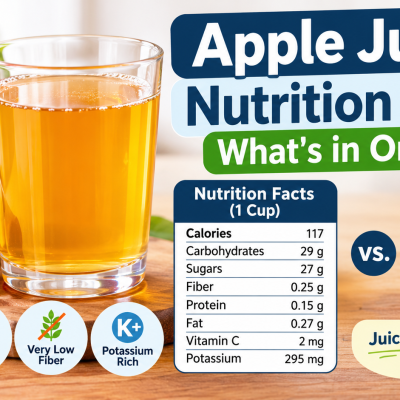
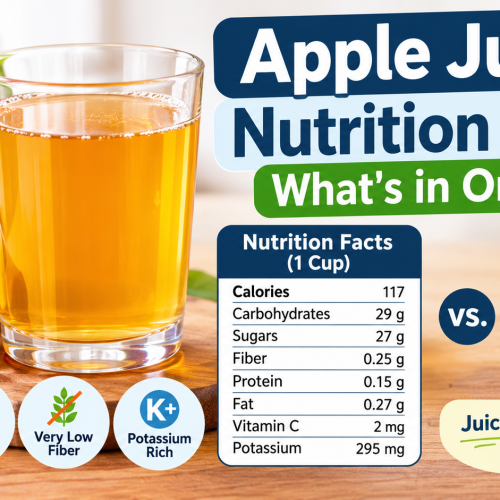
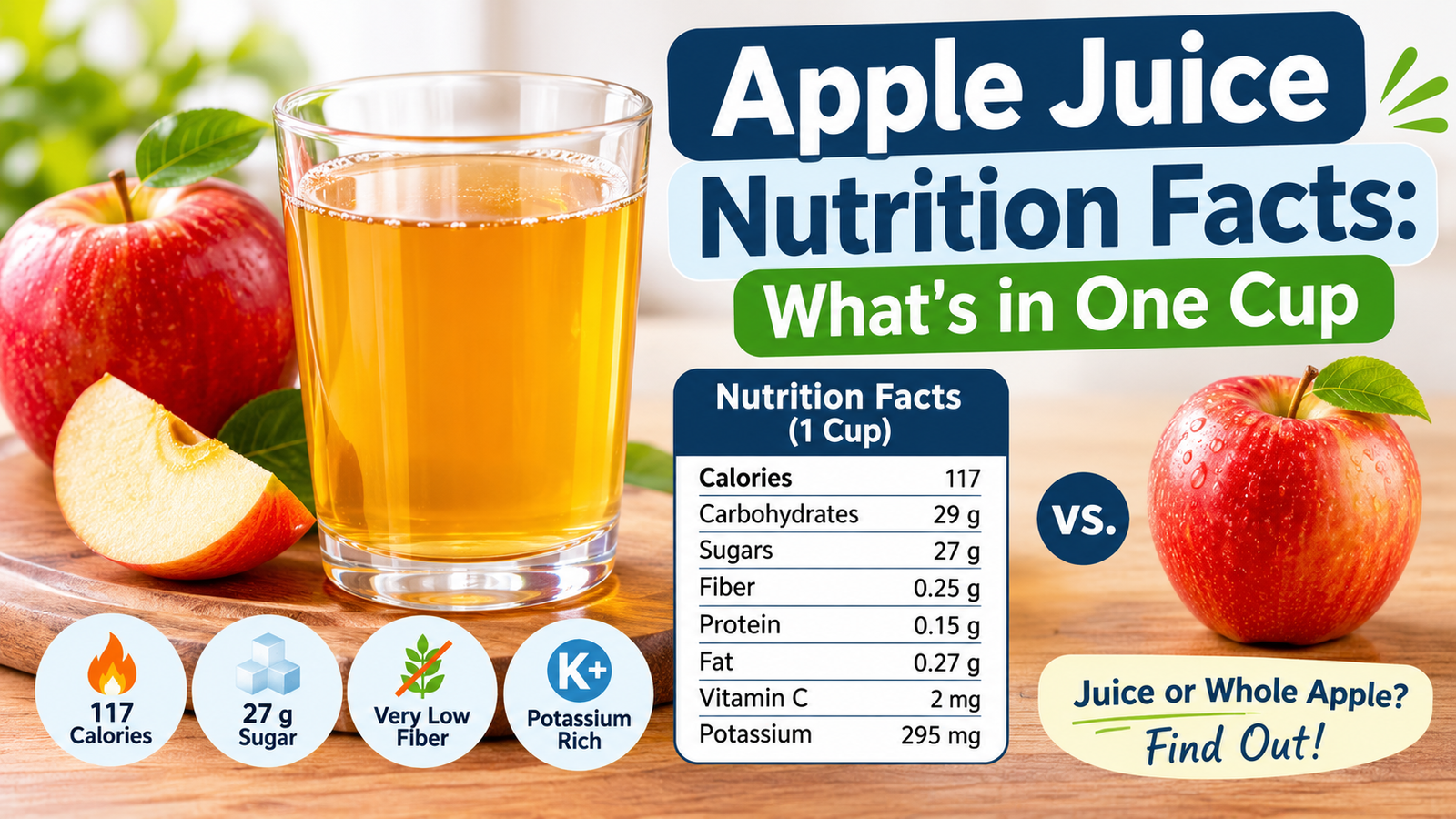
The caloric value is around 117 calories. Carbohydrates present in the juice amount to 29 grams, out of which 27 grams are made up of sugars. Fiber content is negligible, at 0.25 grams. The protein content is 0.15 grams, while that of fat is 0.27 grams. Vitamin C content is 2 milligrams, while potassium content is 295 milligrams.
The page doesn’t say which database the numbers come from, and it gives no data date, so I’d call these good estimates, not exact values. Real products differ by brand. Some are made of concentrates, while others include vitamins. The label on your bottle will tell you more about what you are really drinking.
What stands out
Look at the sugar line first, since it’s the most striking of all the apple juice nutrition facts. About 27 grams of sugar in a cup is a lot, and almost all the carbohydrate is sugar. As a rough guide, a teaspoon of sugar is about 4 grams, so that’s close to seven teaspoons. That’s my own math, not from the page.
Now look at the fiber line. It’s tiny. That’s the big difference between juice and a whole apple, and we’ll get to it below.The good news is that juice does contain some nutrients. Potassium is the standout in the list. But the amounts of most vitamins and minerals are small. I won’t claim health benefits from a cup of juice, because the sources I read don’t promise any.
Juice versus the whole fruit
New Mexico State University has a guide called “MyPlate: The Fruit Group: Focus on Fruits,” revised in November 2018. It says juice can be healthful, but “it is always better to choose more whole fruits than juice because whole fruits contain more fiber.” It also says, “Whole or cut-up fruits are sources of dietary fiber; fruit juices contain little or no fiber.” “You can read the NMSU guide for the full list of tips.
When you compare apple juice nutrition facts with whole fruit, the same guide says that if you need two cups of fruit a day, you could choose one cup of juice and one cup of whole fruit. So juice can count toward your fruit. But the guide lists 100% juice as a food to eat “sometimes, at most several times a week.” And it says one cup of juice equals eight ounces.
This is how I understand it. The whole apple gets you to chew, and the fiber fills you up. The juice in one cup just flows in within minutes. That part is my own view, but it fits what the guide says about fiber.
Check the label.
Not everything found in the juice section of your store is actually juice. As per the NMSU, beverages labeled “fruit punch,” “fruit aid,” and “fruit drinks” do not really contain much juice, so you must look at the label and the percentage of juice it contains. Look out for “100% juice” written at the front of the product and go through the ingredients at the back of the bottle. You will be able to distinguish from the list of added sugars, syrups, and other additional elements.
Moreover, make sure you look at the serving sizes, too, since the nutrition facts about apple juice could be only for some parts of the total volume of the beverage in your hand.
Juice and kids
If a child in your life drinks apple juice, the apple juice nutrition facts matter even more. In 2017, the American Academy of Pediatrics gave advice that CBS News reported on May 22 of that year. It said children under one shouldn’t have fruit juice and quoted a pediatrician calling it “absolutely unnecessary for children under 1.” It said children ages 1 to 3 should be limited to 4 ounces a day. The article didn’t give specific amounts for older kids, only that small amounts in moderation are fine.
It gave reasons too.Juice contains a lot of sugar and calories than the actual fruit because of lack of fiber content. Even in the article, one reason mentioned as to why not to take juice is the fact that it causes tooth decay. This is why health experts warn against giving kids juice in bottles all day long.This information is from 2017, so you should seek the latest information from your child’s physician. It’s also a news report, not the AAP’s own page.
If you have a health condition
Some people have to control their intake of sugar or carbohydrates such as diabetics. I cannot advise you on the best thing for you to do. If you are in that group, it is wise to consult your doctor or a registered dietitian concerning your juice intake. It is a good opportunity to show your label.
How to enjoy juice without overdoing it
Below are suggestions from me rather than the sources I have consulted. Measure your juice in a smaller glass than what you believe you require. Drink from a small cup and not a large glass. Have your juice as part of a meal. And for plain thirst, reach for water. If you like the idea of a cold drink on a hot day, our post on the benefits of drinking cold water may help.
Common mistakes
The most common mistakes people make about nutrition facts for apple juice are to think that juice and fruits are the same thing. The other mistakes people make are to read the front label instead of the actual label, forget about the serving size, buy fruit drinks instead of juice, and let their children drink juice all day.
Your next step
Look at the juice in your fridge right now. Read the label. Is it 100% juice? How many servings does the bottle hold? How many grams of sugar does each serving contain? Once you have these facts, decide what size glass is right for you.
For additional nutritional guidelines on a daily basis, go to Calm Health Tips. The facts about the apple juice nutrition facts are quite straightforward: It is delicious, contains potassium, is high in sugar content, and very low in fiber, making it easy to consume in smaller amounts than in larger quantities.
FAQ
What are the apple juice nutrition facts for one cup?
Based on the information provided by University Hospitals about the nutritional information of the unsweetened fruit juice, there are 117 calories, 29g of carbohydrates, 27g of sugar, and negligible amounts of fiber in a single cup of apple juice.
Does apple juice have fiber?
Very little. The listed amount is about 0.25 grams per cup. NMSU notes that whole fruit has more fiber than juice.
Is apple juice as good as eating an apple?
Not by the sources I read. NMSU says whole fruit is the better choice because it has more fiber.
How much apple juice can kids have?
According to an AAP recommendation in 2017, as mentioned on CBS News, no children less than one year old should drink it while 1 to 3-year-olds can only consume four ounces a day.
Is there any added sugar in apple juice?
There is no sugar in apple juice as long as it is 100% juice and no sweeteners were added.